Sunday, February 13, 2011
LAD #30: Schenck vs. US
The Schenck vs. US Court Case was very influential during the early 1900s in that it upheld the Espionage Act of 1917. On March 3rd, 1919, Charles Schenck was arrested for mailing out flyers denouncing the draft. Being the leader of the Socialist Party, there grew outrage over his charges as many stated that the first amendment protected his freedom of speech. So, he challenged the Espionage Act which made it illegal to interfere with wartime activities. He did not win however as Supreme Court Justice Holmes stated "The most stringent protection of free speech would not protect a man in falsely shouting fire in a theatre and causing a panic. [...] The question in every case is whether the words used are used in such circumstances and are of such a nature as to create a clear and present danger that they will bring about the substantive evils that Congress has a right to prevent."
Saturday, February 5, 2011
LAD #29: Keating-Owen Child Labor Act
The Keating-Owen Child Labor Act passed in 1916 prohibited factories, companies, as well as stores that employed children under 14 from selling their products. Along with this, people were not allowed to buy products from businesses with children under 14 working. Furthermore, this act regulated the hours that 16-year-olds could work. The goal of all this was to completely put an end to child labor. This act came about after the 1900 census showed that close to 2 million children were working in terrible conditions as child laborers. This statistic finally opened up peoples eyes enough to call for changes to occur. The Keating-Owen Child Labor Act was ruled unconstitutional however in 1918 in the Hammer vs. Dagenhart case, but another act getting rid of child labor was passed once again in the same year.
LAD #28: Wilson's First Inaugural Address
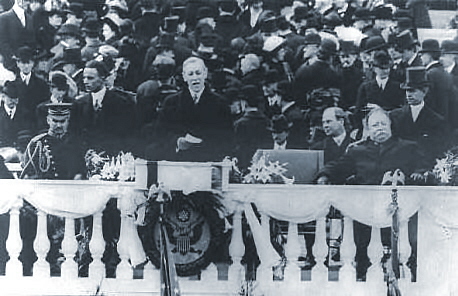
On March 4th 1913, President Woodrow Wilson presented his first inaugural address. In it he discusses how the democrats gained control by winning the majority in the Senate as well as in vice president and president. He goes on to explain that this is more than just a party success in Washington, but instead a success for the country as a whole. He then talks about the citizens of the nation and that it will be one of his goals to help them do good, and steer away from evil. Wilson strongly believes that government's job is to look out for the welfare of its people and he says that he will try to make sure that this happens.
LAD #27: Clayton Antitrust Act
The Clayton Antitrust act solved the problem of dealing with trusts by breaking up all of the bad trusts during the 1900s. It was able to do this by introducing many new regulations on trusts and Big Business in general. First off, businesses could not make prices fluctuate according to who was buying it. If a company were to do this they would be fined. Next, this act made it officially illegal to sell bribes. Also, special deals had to be offered to everyone, not just a specific group of customers. Along with this, if you were to accept a special deal you could also be fined and arrested. This act also made it so that one company could not sell another company's product. To protect workers, if someone were to get hurt on the job, they were now allowed to sue the company they were working under. All in all, this act decreased the monopolistic control of big business.
Monday, January 17, 2011
LAD #26: MLK's "I Have a Dream" Speech
From the Lincoln Memorial, Martin Luther King Jr. gave his famous 'I Have a Dream' Speech on August 28th 1963. Part of the March on Washington, King's speech was presented to millions calling for equal civil rights for all people of any race. He begins this speech referencing the Emancipation Proclamation. He states that after this proclamation was announced the slaves were officially free, yet 100 years later blacks are still not free. He continues this idea mentioning the ways in which blacks are mistreated, discriminated against and segregated. Along with this, King speaks of the Declaration of Independence, and how African Americans still do not receive an equal treatment as whites. King declares that now is the time to change these injustices and abuses of civil rights. He believes that everyone wanting this change must stick together, and never let up. King shares his beliefs in his famous words "I have a dream..." "I have a dream that my four little children will one day live in a nation where they will not be judged by the color of their skin but by the content of their character." This sums up his hopes that through hard work, our nation can one day truly be equal for all people.
Thursday, January 6, 2011
LAD #25: The Dawes Act
Signed into law February 8, 1887, The Dawes Act allowed the U.S. to break up Native American lands into individual parcels. These little chunks of land would be given out to each of the individual Native Americans, and the surplus land was to be sold to white settlers. The plots that were given out to the Native Americans depended on each persons age, as well as if they had a family or not. Furthermore, Native Americans were allowed to choose their own land, and if two people chose the same plot then it would be divided and they'd be given the rest of their land somewhere else. If picks for plots were not made in a certain amount of time (four years), then an agent would pick for them. Native Americans with this land would receive legal patents that would be enforced and protected. These Native Americans were now under U.S. law however. This meant they could be protected by the law, but also could be punished by it. Lastly, Native Americans not a part of any tribe could apply for U.S. citizenship. Tribes such as the Iroquois and the Sioux were not offered these things however.
LAD #24: Bryan's Cross fo Gold
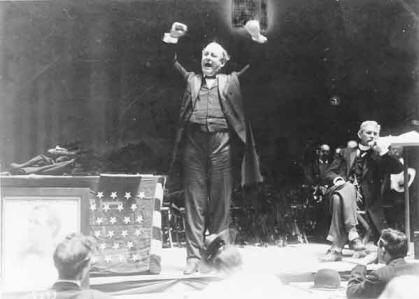
The most famous speech in American history was written and orated by William Jennings Bryan on July 9th, 1896. Given at the Democratic Convention in Chicago, this speech centered around endorsing the free coinage of silver at a 16 to 1 ratio to gold. Bryan starts off his speech by explaining to the crowd that men are born, live and die, but that principles are forever lasting. He declares that the matter at hand is one of these principles. Around this time, a section of the Democratic Party called the silver Democrats took over the Party and spread across the country. There goal was to campaign to try and get silver to be coined freely. These men were unselfish and put their opinions aside and agreed with the majorities views. Bryan explains that northern businessmen got in the way because they were only following their interests, as opposed to those of the common man. He believes that the miners and farmers were equally as good as the businessmen in New England. Bryan explains that this fight for the free coinage of silver is one of the average man, as many farmers needed this to pay off debts. He views the income tax as something good for the people and that government should play a bigger role in coining money. Bryan stood firm in his belief that Americans must move toward bimetallism, instead of just gold.
Subscribe to:
Posts (Atom)